 Reading Time: 3 minutes
Executive Summary: AI-CRRQ™ Cyber Resilience Framework
Date: March 28, 2026
Subject: Site Analysis and Conceptual Overview of AICRRQ.com
1. Introduction and Core Philosophy
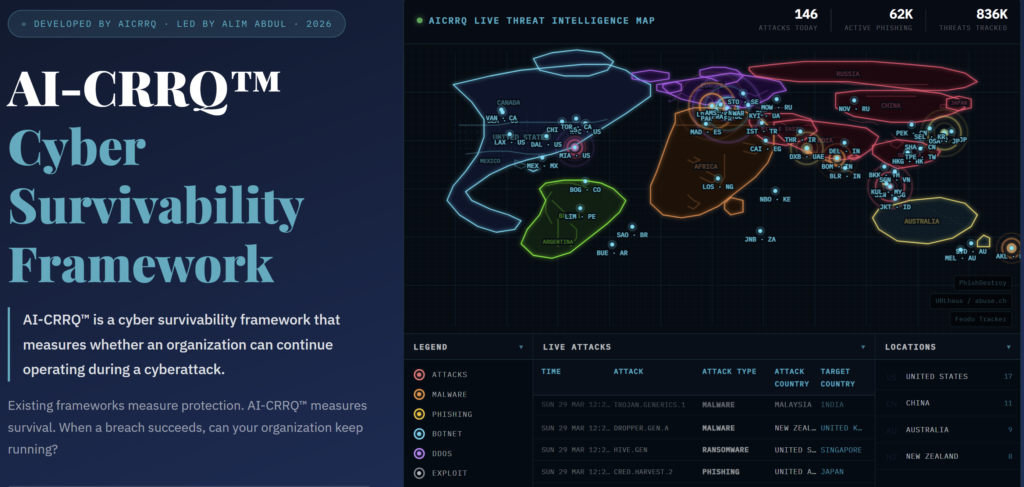
Developed by the AICRRQ Cyber Risk & Resilience Practice and led by Cyber Risk & Governance Advisor Alim Abdul, AI-CRRQ™ is a modern cyber survivability framework. It is built to answer one critical executive question: “Can our organization continue operating during a cyberattack?”
Operating on an “assume breach” philosophy, the framework recognizes that threat actors are increasingly successful at bypassing perimeter defenses. While traditional cybersecurity frameworks (such as NIST CSF, ISO 27001, and Zero Trust) are essential for measuring security maturity, compliance, and protection, AI-CRRQ™ is distinctly designed to measure operational survival during an active crisis.
2. The Survivability Gap
The framework addresses a major vulnerability in modern corporate risk management: the “Survivability Gap.” When traditional protection measures fail, the focus must immediately pivot to continuation. AI-CRRQ™ translates existing security controls and leadership preparedness into a quantifiable operational posture, emphasizing that cybersecurity tools alone cannot prevent operational collapse.
3. The Survival Index™ Methodology
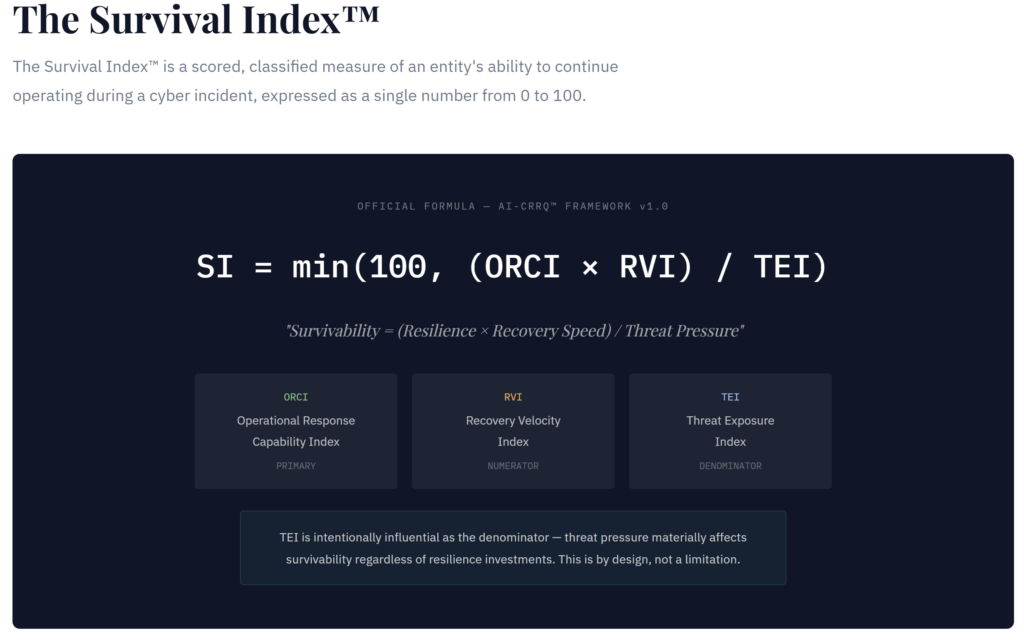
The central output of the AI-CRRQ™ framework is the Survival Index™ (SI). This is a directional metric—scaled from 0 to 100—that calculates an organization’s operational resilience posture based on three primary vectors:
Core Formula: Survival Index™ = min(100, (ORCI × RVI) / TEI)
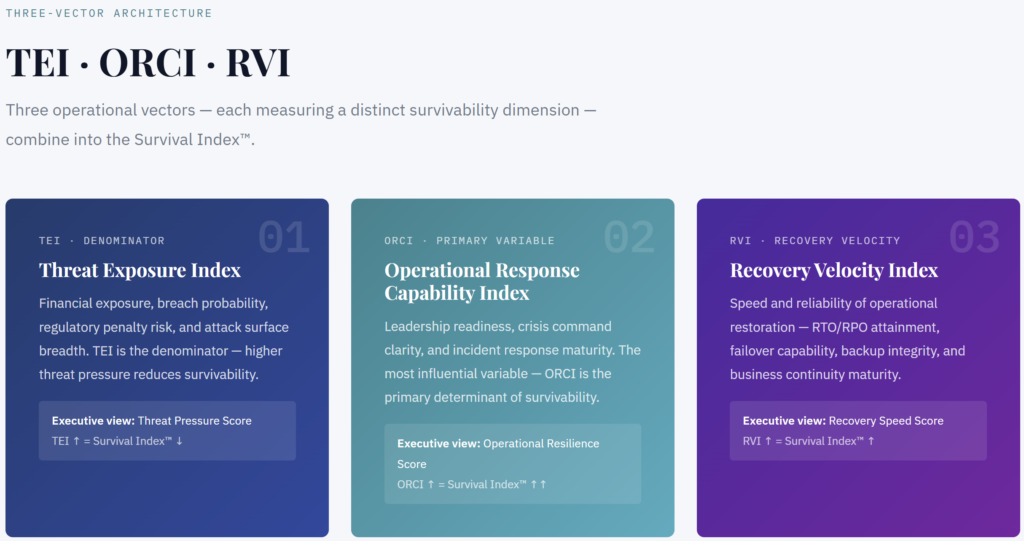
- ORCI (Operational Response Capability Index): The Resilience Driver. This metric measures leadership readiness, crisis command clarity, and incident response maturity. AI-CRRQ™ identifies ORCI as the most influential variable, noting that operations typically fail because leadership cannot sustain command, not simply because defenses were breached.
- RVI (Recovery Velocity Index): The Recovery Driver. This assesses how rapidly and reliably critical operations can be restored. It evaluates Recovery Time Objectives (RTO), Recovery Point Objectives (RPO), failover capabilities, and backup integrity.
- TEI (Threat Exposure Index): The Threat Pressure (Denominator). This measures the organization’s financial exposure, breach probability, regulatory penalty risk, and attack surface breadth. High threat pressure heavily penalizes the overall survivability score, requiring exceptional ORCI and RVI to compensate.
4. Scoring Tiers
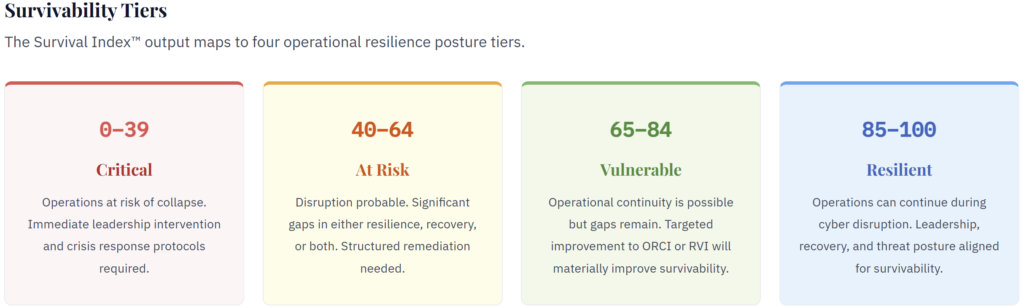
The resulting Survival Index™ score categorizes an organization into one of four operational states:
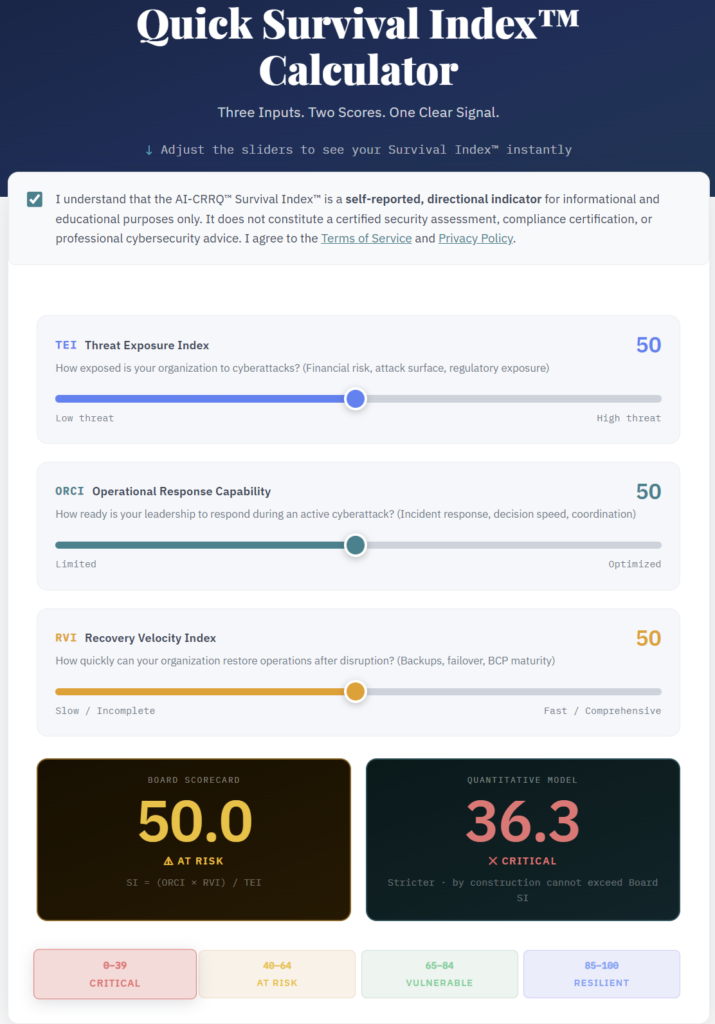
- 85–100 (Resilient): Operations can securely continue during an incident.
- 65–84 (Vulnerable): Notable gaps remain in resilience; intervention is required.
- 40–64 (At Risk): Operational disruption is highly probable during an attack.
- 0–39 (Critical): Operations are at imminent risk of complete collapse.
5. Platform Features and Advisory Services
The AICRRQ.com platform provides practical resources for executives and board members to evaluate their posture:
- Live Survival Index™ Calculator: An interactive, zero-data-collection tool that allows leaders to adjust sliders for ORCI, RVI, and TEI to instantly model their survivability score.
- Live Threat Intelligence Map: A real-time visualization dashboard tracking active global cyberattacks, phishing campaigns, and malware deployments, drawing data from sources like URLhaus and Feodo Tracker.
- Professional Services: Organizations requiring rigorous analysis can book a consultation or request a formal survivability assessment from the AICRRQ practice to transition from baseline awareness to validated operational resilience.
Site Link: AI-CRRQ™ | Cyber Resilience Self-Assessment Framework | AICRRQ.com