 Reading Time: 2 minutes
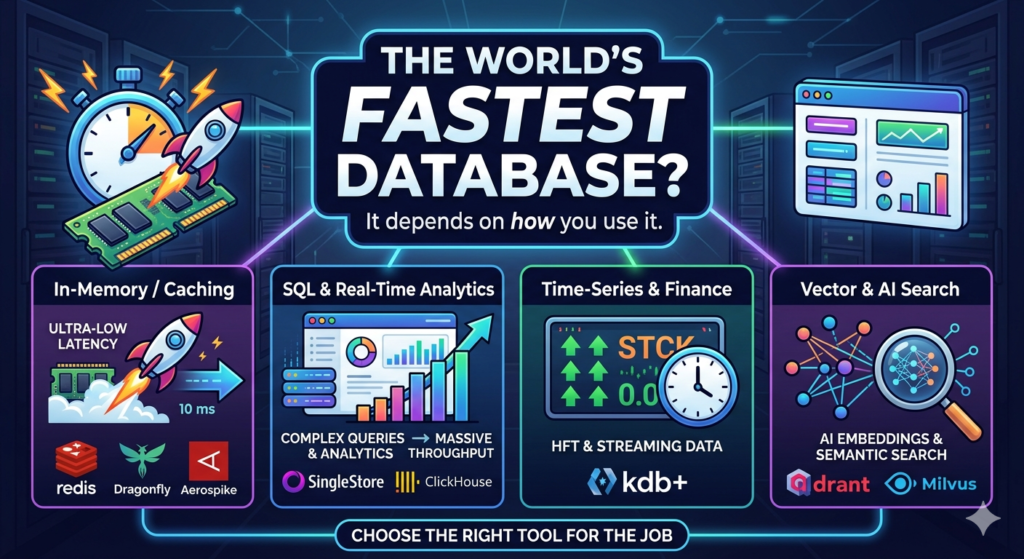
There is no single “world’s fastest database” because database speed depends entirely on the specific workload—such as whether you are doing massive amounts of simple reads, complex analytical queries, high-speed financial transactions, or vector searches for AI.
However, several databases consistently break performance records or claim the title of “fastest” in their respective categories. Here are the top contenders based on different use cases:
1. In-Memory / Key-Value Stores (Fastest for Caching & Simple Reads)
Because they store data in RAM rather than on a hard drive, in-memory databases offer sub-millisecond latency and are generally the fastest databases on the planet for raw operations per second.
- Redis: Historically the gold standard for speed, Redis is an in-memory data structure store used heavily as a cache and message broker.
- Dragonfly: A modern, multi-threaded drop-in replacement for Redis. In benchmarks, Dragonfly has handled millions of requests per second on a single instance, often claiming to be up to 25x faster than Redis for certain high-throughput workloads.
- Aerospike: A highly optimized key-value NoSQL database known for predictable, ultra-low latency at massive scale, heavily used in ad-tech and fraud detection.
2. NewSQL & Real-Time Analytics (Fastest for SQL & Transactions)
If you need a traditional relational database (using SQL) that can handle both massive transactional write speeds (OLTP) and rapid analytical queries (OLAP) simultaneously:
- SingleStore (formerly MemSQL): SingleStore frequently markets itself as the “world’s fastest distributed SQL database.” It ingests millions of rows per second while allowing you to run complex analytics on that same data without delay.
- ClickHouse: An open-source, column-oriented database that is legendary for its blazing-fast analytical query execution. It routinely tops benchmarks for reading and aggregating massive datasets.
3. Time-Series Databases (Fastest for Financial & Sensor Data)
- kdb+ (by KX): Long considered the fastest time-series database in the world. It is the undisputed king in the financial sector for high-frequency algorithmic trading, capable of analyzing billions of streaming records per second. It uses a highly optimized programming language called “q”.
4. Enterprise Hardware & Software Combos
- Oracle Exadata: Oracle routinely calls its Exadata machines the “World’s Fastest Database Machine.” By tightly coupling Oracle Database software with specialized compute, storage, and persistent memory hardware, they achieve microscopic latency and massive throughput for heavy enterprise workloads.
5. Vector Databases (Fastest for AI & Machine Learning)
With the rise of Generative AI, databases designed to quickly search high-dimensional vectors have become critical.
- Qdrant & Milvus: In recent independent benchmarks (like those on ANN-Benchmarks), Qdrant and Milvus consistently trade blows for the highest and lowest latency when filtering and searching through millions of AI embeddings.
Summary:
- Raw, sub-millisecond data retrieval, look at Dragonfly or Redis.
- If you are doing high-frequency stock trading, kdb+ is the standard.
- For blazing-fast SQL and real-time analytics, SingleStore and ClickHouse are top-tier.